
Vajpayee had always felt that India must act with conviction and panache. He decided that, irrespective of the attendant risks, he would undertake what many felt was a precarious course. A fascinating excerpt from N K Singh's Portraits Of Power: Half A Century Of Being At Ringside on Atalji's 96th birthday, December 25.

Opposition parties on Thursday launched a vociferous attack on the Centre over its handling of the farmers' agitation, callings its dialogues with the protestors 'monologues', even as the ruling Bharatiya Janata Party defended the new laws asserting that its government is committed to the welfare of peasants and increase their incomes.
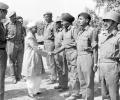
Anil Shastri, one of the late prime minister's six children, recounts memories of his father.

India lacks China's culture of collective discipline, so what will provide the glue for people to cooperate rather than follow their raw survival instincts? asks Ravi Bhoothalingam.

'Lingering border disputes and fierce geostrategic competition in South Asia between China and India are likely to temper any cooperation Beijing might hope to achieve with New Delhi in the SCO,' says P K Vasudeva.
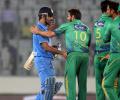
The much-awaited India-Pakistan World Twenty20 clash is in jeopardy after the Himachal Pradesh government expressed its inability to provide security for the match, leaving the Board of Control for Cricket in India (BCCI) in a bind with Board Secretary Anurag Thakur saying that the state should not 'play politics'.
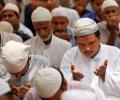
'No country or society ever prospered or remained secure by marginalising more than one-sixth of its own,' warns Shekhar Gupta.

She said the situation arising out of demonetisation has triggered a sort of constitutional crisis.

'The people of Pakistan and India will begin to understand what the bottom lines are. What India can accept maximum is known to Pakistan. What Pakistan can accept minimum is known to India.' 'In the absence of atmosphere you can't even talk, you can't think of writing agreements and frameworks. You have to have the right atmosphere. With the previous BJP government it had started and I hope the new BJP government will continue with that.'

The Emergency greatly influenced the RSS' makeover from a fringe force in the Indian political imagination to one that could have its own man sworn in as prime minister in two decades' time. A riveting excerpt from Christophe Jaffrelot and Pratinav Anil's India's First Dictatorship: The Emergency, 1975-1977.

In a letter addressed to Prime Minister Narendra Modi, the Ladakh MP revealed his reason to quit the BJP and resign from the Lok Sabha ahead of the upcoming parliamentary elections.
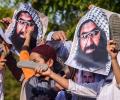
The three countries have indicated that they are willing to accommodate Chinese request for changes in the language as long as it does not change the substance of the resolution and it ends up designating Azhar as a UN global terrorist.

'As events at Kargil and Pakistan's continued support to terror activities in India prove, Pakistan has always felt that the break-up/destruction of India was within its capability,' notes Colonel Anil A Athale (retd).

Prime Minister Khan said his government was keen to bring the perpetrators of the 2008 Mumbai attack to book, asserting that it was in the interest of Pakistan.

Despite drawing a blank in Tamil Nadu, its leaders in the state claimed they should strike roots without using a crutch at this "most opportune" time, reports Radhika Ramaseshan.
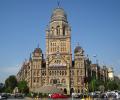
As the Bharatiya Janata Party and the Shiv Sena refused to blink, the opposition, the Congress and the Nationalist Congress Party are keen to take the benefit, reports Sanjay Jog.
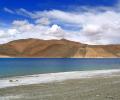
'It is pure luck that we did not have any body bags, otherwise things could have been nasty.'
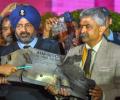
The tri-services chiefs while addressing the media also said that the forces were in a state of heightened readiness to deal with any eventuality.
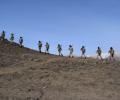
India brought in more troops after the destruction of two of its bunkers and "aggressive tactics" adopted by the Chinese People's Liberation Army

'By beheading an Indian soldier, the Pakistan army has demonstrated its proclivity for barbaric medievalism.' 'The strategies adopted and the punishment inflicted by India must be made progressively more stringent with every new act of terrorism till the cost becomes prohibitive for Pakistan,' says Brigadier Gurmeet Kanwal (retd).
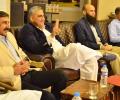
'Over the last year, Bajwa has created the environment to support bold moves on India. The ball is in India's court,' a senior Pakistan military officer tells Ajai Shukla.
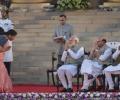
ially powerful ones, usually find themselves surrounded by people who will not oppose them. 'This is because those who are cautious and of a different view will not find satisfaction serving an individual so different from them, producing results they do not agree with,' says Aakar Patel.
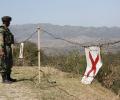
'The response to terror is not always reciprocal terror, nor is launching a conventional response the best response.' 'The best response is to make the sponsor pay a price he cannot afford,' says former RA&W chief Vikram Sood.
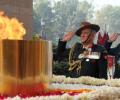
"The force is to maintain peace and tranquillity at the border but it will not shy away from flexing its muscles, if the need be," Gen Rawat said.

'We don't know what the reasons were that we gave back the Haji Pir Pass which was strategically very important. Today the entire infiltration into Kashmir takes place from that area. If we had retained that post that we had captured, things could have been different.' 'A lesson we need to learn is if you start losing the gains of war at the negotiating table, they become a disincentive for future wars,' says Lieutenant General D B Shekatkar (retd), reviewing the lessons from the 1965 War.

'We owe our existence to the men in uniform, and we owe it to them to cleanse the armed forces by driving away every bit of corruption that eats into it,' argues Sudhir Bisht.

A Muslim man's beard was allegedly shaved off in Gurugram.
The HM said that Rahul went on foreign tours and informed the SPG at the eleventh hour, creating problems for it to provide proper security.
The FinCom has recommended a record 10% increase in states' share.
'The best course for India is to wait out the implosion that is bound to take place in Pakistan sooner than later.' 'We have to ensure that the fallings debris from a collapsing State does not damage us,' says Colonel Anil A Athale (retd).

Arpi deserves to be complimented for the commitment and hard work that have gone into this production. The frustrations of seeking reliable documentation from the catacombs of the Indian bureaucracy did not deter him from going after the best information available, and the result is one that he can take much satisfaction in. Ambassador Prabhat P Shukla, Member Advisory Council, Vivekananda International Foundation, reviews Claude Arpi's The End of an Era: India Exits Tibet.

'The Pakistanis were lulled adequately to provide one of the fundamental prerequisites for successful execution of such an option: Surprise.' 'The other requisite: Deception in terms of selection of areas for launch/time of offensive action,' explains Brigadier S K Chatterji (retd).

The government's decision of not approving Joseph's name has evoked sharp reactions.
While the BJP has taken a beating, its leader still stands tall, points out T N Ninan.
'Modi as chief minister did a superb job of rehabilitation after the Kutch earthquake of 2001. He can use that hard-earned expertise for the benefit of the people of Kashmir too -- but only if they let him do so,' says T V R Shenoy.

There are limitations to milking national security, says Sanjeev Nayyar.

The plan hinged on two critical assumptions: India would not be able to replenish supplies quickly to launch a counter-attack. India could not respond in enough strength to dislodge the Pakistanis. Both assumptions would be proved wrong due to the ferocity of the Indian response, reveals former RAW officer Tilak Devasher in his new book, Pakistan At The Helm.

Mufti's political graph shows his fondness for courting unpopular, politically hazardous ventures in pursuit of his ultimate objective to vindicate his leadership. Towards the end of his life, Mufti's public profile had come to assume the dimensions of statesmanship. One reason being his willingness to learn from his experience, says Mohammad Sayeed Malik.
'I do not think it's possible for the winners and losers to shake hands and go back to regular business at the end of this.' 'It seems visceral, personal and nasty at a depth we have not plumbed before,' says Aakar Patel.

The terror strike on Mumbai, carried out by ten suicidal terrorists and planned by the Lashkar-e-Tayiba, had cost less than Rs 25 lakh.
